

Rigveda Foundational Orientation



Introduction: Knowledge Was a Way of Life
Today, knowledge is usually measured by:
-
Degrees
-
Exams
-
Careers
-
Information
In ancient India, knowledge meant something much deeper.
It was not merely about knowing facts.
It was about understanding life, reality, and oneself.
Knowledge was seen as a transformative journey, not just an academic pursuit.
1. Knowledge Was Sacred Discovery, Not Invention
Ancient Indian thinkers believed knowledge already existed in the universe.
Human beings did not create knowledge.
They discovered it through:
-
Observation
-
Reflection
-
Experience
-
Meditation
This is why the word Veda means knowledge or wisdom that is known.
Learning was therefore a sacred act of discovering truth, not inventing it.
2. Knowledge Had Two Dimensions
Ancient Indian education clearly distinguished between outer knowledge and inner knowledge.
Outer Knowledge (Practical Knowledge)
This included:
-
Mathematics
-
Medicine (Āyurveda)
-
Astronomy
-
Grammar
-
Music and arts
-
Agriculture and crafts
This helped people live successfully in the world.
Inner Knowledge (Self-Knowledge)
This included:
-
Understanding the mind
-
Understanding consciousness
-
Understanding the Self (Ātman)
-
Understanding reality
This helped people live wisely in life.
Ancient education aimed to balance both.
3. Knowledge Was Meant to Remove Ignorance
Ancient Indian philosophy often described ignorance (Avidya) as the root of suffering.
Ignorance meant:
-
Misunderstanding reality
-
Confusion about the self
-
Living without awareness
True knowledge (Vidya) removes this ignorance.
Thus, knowledge was seen as a tool for freedom, not just success.
4. Learning Required Experience
Memorizing texts was only the first step.
Ancient Indian traditions described three stages of learning:
-
Śravaṇa — Listening
Receiving knowledge from teachers and texts. -
Manana — Reflection
Questioning, debating, and thinking deeply. -
Nididhyāsana — Realization
Direct experience and personal understanding.
Knowledge was complete only when it became lived experience.
5. Education Was Holistic and Interconnected
Ancient scholars did not divide subjects into isolated fields.
A student might learn:
-
Logic and philosophy
-
Language and poetry
-
Astronomy and mathematics
-
Ethics and psychology
The universe was seen as one interconnected reality.
Therefore, knowledge had to be holistic.
6. The Role of the Guru–Shishya Tradition
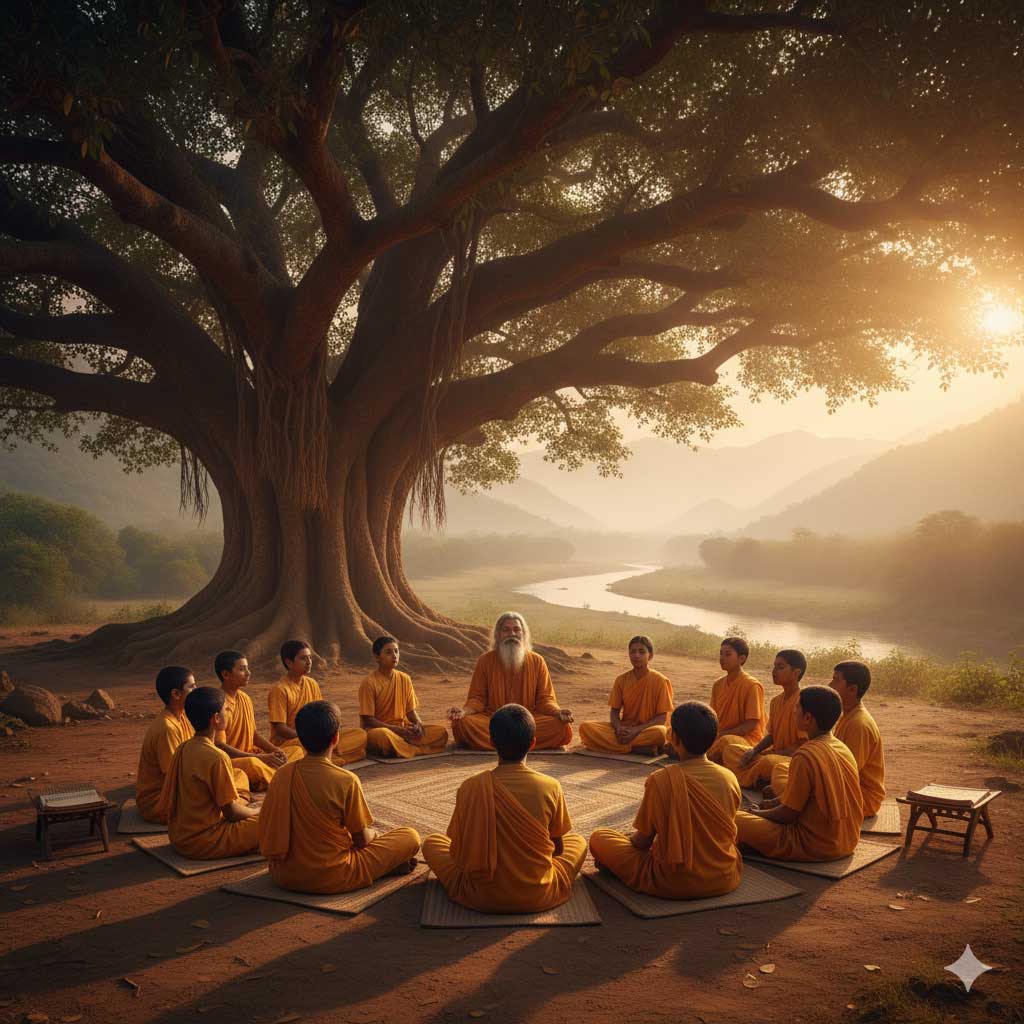
Education happened through the Guru–Shishya (teacher–student) relationship.
This system emphasized:
-
Personal guidance
-
Dialogue and questioning
-
Learning through daily life
-
Character development
Education was not just classroom learning.
It was living with knowledge.
7. Knowledge Required Humility
Ancient Indian texts repeatedly highlight humility as essential for learning.
True scholars were expected to be:
-
Curious
-
Open-minded
-
Respectful
-
Aware of the limits of knowledge
The deeper one studied, the more one realized:
There is always more to learn.
Conclusion: Knowledge as Transformation
For ancient Indians, knowledge was not simply a means to earn a living.
It was a way to:
-
Understand reality
-
Improve society
-
Cultivate wisdom
-
Achieve inner freedom
Knowledge was not just something you had.
It was something you became.
This vision of learning remains deeply relevant even today.
