
Kama Sutra - Awareness & Misconceptions
When the term Kama Sutra is mentioned, the modern mind almost instinctively conjures images of elaborate sexual positions, exotic illustrations, and whispers of forbidden pleasure. Bookstores shelve it under erotica, pop culture reduces it to a manual for acrobatic intimacy, and for centuries, the West has treated it as little more than ancient India’s contribution to the art of lovemaking.
This reduction, however, is one of history’s most persistent cultural misconceptions. To view the Kama Sutra solely as a sex manual is akin to reading Leo Tolstoy’s War and Peace as a handbook on military strategy—technically not incorrect, but profoundly incomplete. The reality is far richer. Compiled by the sage Vatsyayana Mallanaga sometime between the 2nd and 4th centuries CE, the Kama Sutra is, in truth, a sophisticated philosophical treatise on the art of civilized living. It is a text concerned with urbanity, psychology, social conduct, and the pursuit of a balanced, meaningful life.
The Three Pillars: Dharma, Artha, and Kama
To understand the Kama Sutra, one must first abandon the modern tendency to isolate “kama” (desire) from the larger framework of Indian philosophy. Vatsyayana begins his work not with a chapter on seduction, but with a discussion of the Purusharthas—the four aims of human life. According to this worldview, a life well-lived rests on three foundational pillars: Dharma (righteousness or ethical duty), Artha (prosperity and livelihood), and Kama (pleasure, desire, and emotional fulfillment).
What is striking about Vatsyayana’s approach is that he does not elevate Kama above the others. Instead, he insists on harmony. He argues that a person who focuses exclusively on Artha becomes a miser; one who focuses exclusively on Kama becomes dissipated and reckless; and one who ignores Kama altogether fails to experience the fullness of human existence. In this framework, the pursuit of pleasure is not sinful or shameful—it is a legitimate and necessary component of a balanced life, provided it is pursued with wisdom, ethics, and self-awareness.
This alone reframes the Kama Sutra as a work of life philosophy. It asks the reader not “how to have better sex,” but rather “how to live a life in which desire enriches rather than destroys.”
The Naggaraka: The Ideal Urbanite
Perhaps the most illuminating section for those seeking to understand the Kama Sutra as a guide to living is its detailed description of the Naggaraka, or “the gentleman of the city.” In Book I, Vatsyayana outlines the daily routine, habits, and social skills required of a cultured urban man. This figure is not a hedonist obsessed with conquest; he is a man of refinement, education, and emotional intelligence.
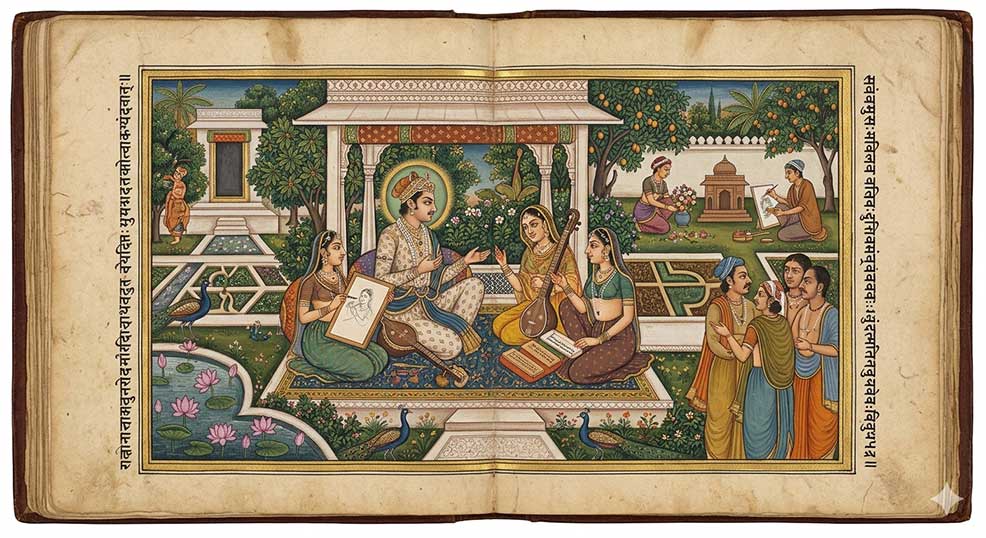
The Naggaraka is expected to pursue the 64 arts (Chaturashtasi Kalas). These include skills like singing, playing musical instruments, painting, architecture, cooking, flower arrangement, conversation, and even carpentry. The underlying message is clear: a civilized person is a well-rounded person. Sexual prowess, according to Vatsyayana, is only truly effective when accompanied by intellectual depth, creative talent, and social grace.
Moreover, the Naggaraka is instructed on how to maintain his home, how to dress, how to host gatherings, and—crucially—how to treat women with respect. He is taught to seek companions who share his intellectual interests and to value wit and conversation as much as physical attraction. In this sense, the Kama Sutra is arguably one of the earliest surviving texts in the world to articulate a philosophy of emotional intelligence and social sophistication.
Consent, Female Pleasure, and Psychological Depth
Another revelation awaiting those who read the Kama Sutra in its entirety is its remarkably progressive—even by modern standards—treatment of female agency and pleasure. Vatsyayana dedicates extensive passages to the psychology of women, emphasizing that desire is mutual and that the satisfaction of the female partner is paramount.
He introduces the concept of the Savitri, or the educated woman who is not merely an object of desire but an active participant in intellectual and romantic life. He distinguishes between different types of attraction and warns against coercion, stating explicitly that intimacy without mutual inclination leads only to “fear, hatred, and disappointment.” This emphasis on consent and mutual pleasure challenges the misconception that the text is a patriarchal manual designed solely for male gratification.
Vatsyayana also explores the emotional landscape of relationships—jealousy, long-term attachment, rivalry, and the dynamics of power. He advises on how to navigate these complexities with integrity. Far from being a clinical list of techniques, the Kama Sutra is a nuanced study of human psychology.
The Forgotten Chapters: Courtship, Family, and Society
If one opens a modern, heavily abridged edition of the Kama Sutra, they often find only the sections dealing with physical intimacy. But the original text is divided into seven books, and the famous sexual positions (the Bandhas) occupy only a portion of the second book.
The remaining books cover subjects such as:
- Acquiring a wife: A detailed guide on courtship, family alliances, and the qualities to seek in a partner.
- The duties of a wife: Instructions on managing a household, maintaining harmony, and fostering long-term affection.
- The Ganika or courtesan: A surprisingly empowering section that outlines how a woman of independent means could cultivate her intellect, arts, and social network to achieve influence and respect.
- Potion and spells: Sections on rekindling desire and managing relationships.
These chapters reveal that Vatsyayana was less interested in sexual technique and far more concerned with the architecture of successful human relationships.
Why the Misconception Persists
So how did a sophisticated philosophical text become reduced to a “dirty book”? The answer lies largely in the colonial encounter. During the British Raj, 19th-century orientalists and translators like Sir Richard Burton, who produced the first English translation, sensationalized the Kama Sutra. Operating within the prudish moral constraints of Victorian England, they framed it as an exotic, forbidden text. Subsequent publishers followed suit, stripping away the philosophical context and re-packaging the Kama Sutra as pornography to maximize sales.
This legacy has stuck. Today, most people encounter the Kama Sutra through illustrated coffee-table books that feature only the anatomical diagrams, divorced entirely from Vatsyayana’s philosophy. The result is a profound cultural loss—a reduction of a rich, multidimensional work into a one-dimensional caricature.
A Guide for Modern Living
Reading the Kama Sutra through the lens of its original intent offers surprising relevance for contemporary life. In an age of digital distraction, Vatsyayana’s emphasis on cultivating the 64 arts feels like a call to depth and creativity. In a culture grappling with toxic masculinity, his vision of the Naggaraka—a man who values intellect, emotional intelligence, and mutual pleasure—offers a timeless archetype. In a world where stress often overwhelms joy, his insistence that pleasure is a legitimate pursuit, when balanced with ethics and purpose, provides a counterpoint to modern burnout.
The Kama Sutra is not merely a book about love. It is a book about how to eat well, how to converse elegantly, how to build a home, how to navigate the complexities of relationships, and how to infuse daily life with art and intention. It asks us to become civilized in the deepest sense of the word—to cultivate our minds, honor our desires, and pursue pleasure not as a guilty escape, but as an integral part of a life well-lived.
In reclaiming the Kama Sutra from its modern misrepresentation, we do more than correct history. We rediscover a blueprint for living with purpose, refinement, and joy.
