
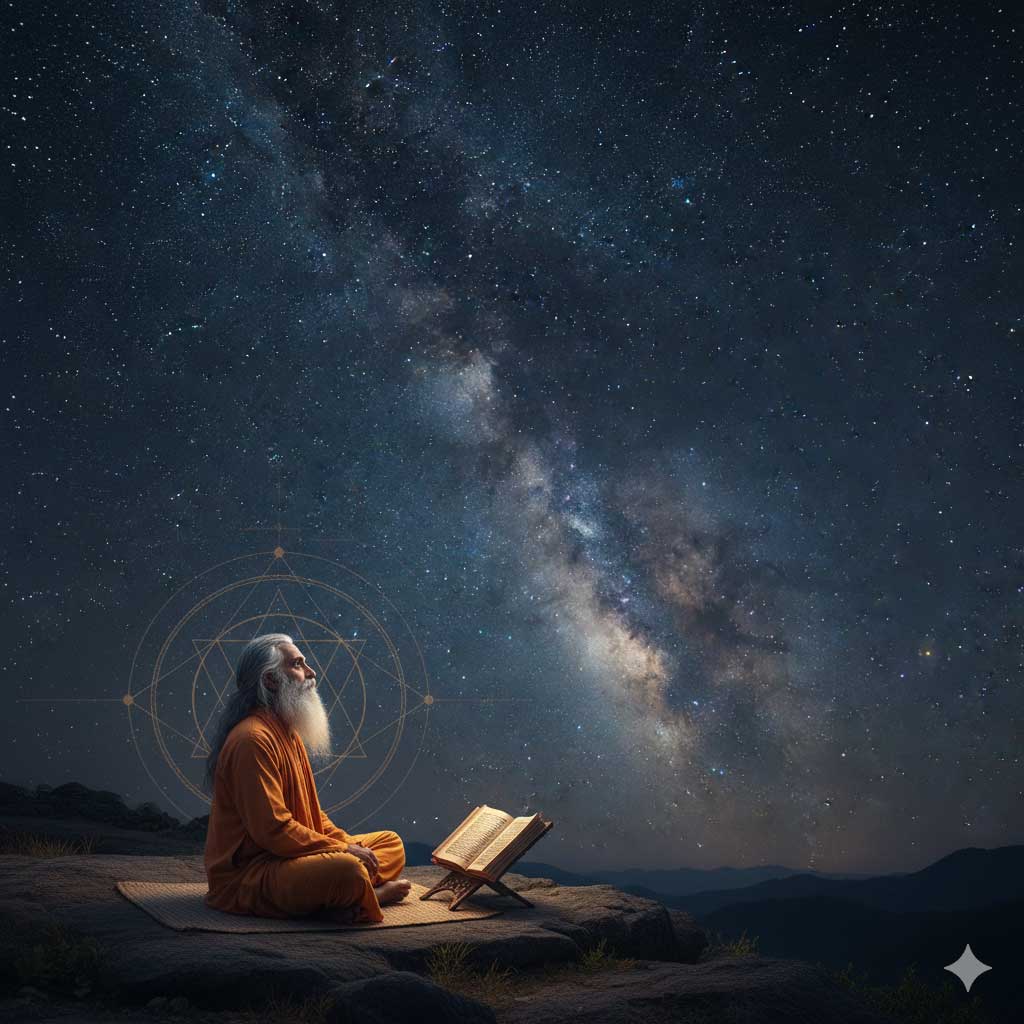
Rigveda Foundational Orientation




Introduction: A Tradition That Embraced Questions
Many people assume ancient wisdom traditions provided absolute answers about the universe.
The Vedic tradition often did the opposite.
Instead of declaring final truths, Vedic thinkers repeatedly expressed:
-
Wonder
-
Curiosity
-
Intellectual humility
-
Openness to mystery
In Vedic thought, uncertainty was not weakness.
It was a sign of deep wisdom.
1. The Universe as a Mystery, Not a Problem to Solve
Modern thinking often treats the universe as a puzzle that must be solved.
Vedic thinkers approached it as a mystery to be explored.
Rather than asking:
“What is the final answer?”
They asked:
“What questions should we continue asking?”
This mindset shaped the tone of many Vedic hymns.
2. The Famous Creation Hymn and Radical Doubt
One of the most striking examples comes from the Nasadiya Sukta (Rigveda 10.129), often called the Creation Hymn.
It asks:
-
How did the universe begin?
-
Who created it?
-
Did it create itself?
And then concludes with a remarkable statement:
Perhaps even the highest reality does not know.
This is an extraordinary example of intellectual humility in ancient literature.
3. Knowledge as an Ongoing Process
Vedic thinkers saw knowledge as:
-
Expanding
-
Evolving
-
Deepening
Not as a finished system.
Truth was not treated as a fixed doctrine but as a continuous discovery.
This encouraged:
-
Dialogue
-
Debate
-
Reflection
-
Interpretation
4. Humility as a Foundation of Learning
Uncertainty cultivated humility.
The Vedic worldview valued the idea that:
-
Human perception is limited
-
Reality is vast
-
Understanding is always partial
This mindset prevented dogmatism and encouraged open inquiry.
5. Multiple Perspectives Were Encouraged
A famous Vedic idea states:
“Truth is one; the wise speak of it in many ways.”
This reflects a deep acceptance of:
-
Diverse viewpoints
-
Multiple interpretations
-
Intellectual pluralism
Uncertainty allowed space for many perspectives to coexist.
6. The Link Between Wonder and Wisdom
Uncertainty generates wonder.
Wonder leads to:
-
Curiosity
-
Observation
-
Reflection
Thus, uncertainty was seen as the starting point of wisdom.
Without uncertainty, there is no reason to explore.
7. Relevance in the Modern World
Today, science also embraces uncertainty.
Scientific progress depends on:
-
Questioning assumptions
-
Testing ideas
-
Accepting incomplete knowledge
In this way, the Vedic attitude toward uncertainty feels remarkably modern.
Conclusion: The Courage to Not Know
Vedic thought teaches a powerful lesson:
Not knowing is not a failure.
It is the beginning of understanding.
By embracing uncertainty, Vedic thinkers created a culture of inquiry that continues to inspire today.
