
Dhyanam 1
Dhyānam 1 — Atulita Bala Mandala
The Abode of Incomparable Strength
The Verse
अतुलितबलधामं स्वर्णशैलाभदेहम् ।
दनुजवनकृशानुं ज्ञानिनामग्रगण्यम् ॥atulita-baladhāmaṃ svarṇa-śailābha-deham ।
danuja-vana-kṛśānuṃ jñāninām-agragaṇyam ॥
Simple Meaning
I meditate upon Hanuman, the abode of incomparable strength, whose radiant form resembles a golden mountain, who is like a blazing fire consuming the forest of destructive forces, and who stands foremost among the wise.
Central Image — Strength Resting in Stillness
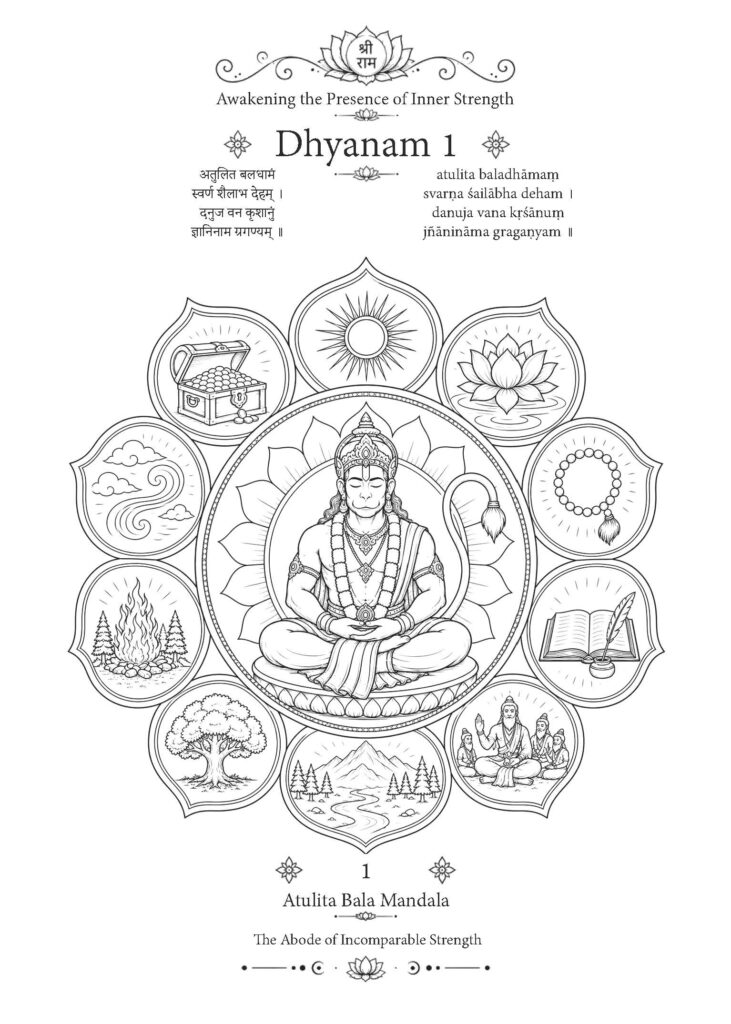
At the centre of the mandala, Hanuman sits in a peaceful meditative posture. Although the verse praises his incomparable strength, he is not shown fighting, leaping or displaying his power.
This is deliberate.
The image teaches that true strength does not always announce itself through action. At its highest level, strength becomes a quiet, stable presence. Hanuman’s closed eyes, balanced posture and composed expression reveal power governed by wisdom.
The large lotus behind him represents awakened consciousness. Hanuman’s strength is rooted in purity, devotion and inner discipline. His tail curves upward, indicating alertness and contained energy even while the body remains still.
The central teaching is:
Real strength is not agitation or aggression. It is power resting peacefully within a disciplined being.
The Ten Symbolic Petals
Moving clockwise from the top:
1. Radiant Sun — Divine Energy
The sun represents inexhaustible energy, clarity and life-giving power. Like the sun, Hanuman’s strength illuminates and sustains rather than oppresses.
It also recalls Hanuman’s relationship with Sūrya, from whom he received sacred knowledge.
Inner teaching:
May my strength bring clarity and encouragement to others.
2. Blooming Lotus — Purity
The lotus represents purity, spiritual awakening and freedom from inner contamination. It grows in muddy water yet remains unstained.
Hanuman participates fully in the world but remains untouched by pride, greed and selfish desire.
Inner teaching:
May I remain inwardly pure even when circumstances are difficult.
3. Japa Mālā — Discipline and Devotion
The prayer beads represent constant remembrance, concentration and spiritual practice. Hanuman’s strength is not separated from devotion; it is refined through remembrance of Rama.
Each bead suggests one repeated act of faith, patience or self-mastery.
Inner teaching:
May regular practice make my mind steady and my strength dependable.
4. Open Scripture and Quill — Sacred Knowledge
The open book represents learning, reflection and scriptural wisdom. The quill indicates that knowledge must be studied, contemplated and communicated.
This symbol expresses jñāninām agragaṇyam—Hanuman is foremost among the wise.
Inner teaching:
May I seek knowledge with humility and use it responsibly.
5. Guru with Disciples — Wisdom Shared
The teacher surrounded by students represents the living transmission of wisdom. True knowledge is not merely accumulated; it is shared for the benefit of others.
Hanuman becomes a teacher through his speech, conduct, devotion and service.
Inner teaching:
May what I learn become a source of guidance and benefit to others.
6. Mountain and Flowing River — Steadfastness and Service
The mountain represents firmness, endurance and immovable conviction. The river flowing from it represents compassionate action.
Hanuman combines both qualities: he is steady in purpose yet responsive to the needs of the world.
Inner teaching:
May I remain firm in my values while allowing kindness to flow through my actions.
7. Great Tree — Rooted Strength
The tree represents stability, patience and generous protection. Its roots remain hidden, but they support everything visible above the ground.
Similarly, Hanuman’s outward strength arises from unseen roots—devotion, humility, discipline and self-knowledge.
Inner teaching:
May I strengthen my inner roots before seeking outward recognition.
8. Forest Fire — Transformation of Negative Forces
The fire burning through the forest directly represents danuja-vana-kṛśānum—Hanuman is the fire that consumes the forest of destructive forces.
The “forest” may also be understood inwardly as fear, pride, anger, confusion and harmful habits. The fire is not uncontrolled rage; it is discerning energy that removes what prevents growth.
Inner teaching:
May courage burn away the tendencies that weaken my character.
9. Moving Wind — Vital Energy and Freedom
The flowing wind recalls Hanuman as the son of Vāyu. Wind is invisible, yet its presence is known through its movement and effects.
It represents life-force, speed, freedom, adaptability and energy that cannot be confined.
Inner teaching:
May my energy remain free from fear but guided by a worthy direction.
10. Treasure Chest — Inner Richness
The treasure chest symbolizes the immeasurable wealth contained within Hanuman: strength, wisdom, courage, devotion, humility and virtue.
The greatest treasure is not material possession but developed character.
Inner teaching:
May I recognise and cultivate the sacred possibilities already present within me.
Overall Philosophical Message
The verse brings together four dimensions of Hanuman:
| Expression from the verse | Inner significance |
|---|---|
| Atulita-bala-dhāma | Incomparable inner strength |
| Svarṇa-śailābha-deha | Radiant and mountain-like stability |
| Danuja-vana-kṛśānu | Courage that destroys destructive forces |
| Jñāninām-agragaṇya | Wisdom guiding the use of power |
The mandala teaches that strength becomes sacred only when it is joined with wisdom, purity, discipline and service.
Without wisdom, strength can become destructive.
Without strength, wisdom may remain inactive.
In Hanuman, the two become one.
Colouring with Intention
This mandala is not simply a picture to be decorated. It can become a quiet practice of reflection.
You do not need to finish it in one sitting. Colour slowly, symbol by symbol. Allow each section to remind you of a quality you wish to awaken within yourself.
Before You Begin
Sit comfortably and take three slow breaths.
Silently repeat:
“May the strength within me be guided by wisdom, humility and service.”
If you prefer, chant:
Śrī Rāma Jaya Rāma Jaya Jaya Rāma
or
Om Hanumate Namaḥ
Begin colouring only after the breath and mind become calm.
Suggested Colouring Journey
1. Begin with Hanuman
Colour the central figure first.
As you colour, reflect:
“Strength already exists within me. May I learn to use it wisely.”
Suggested colours:
- Soft golden or warm ochre for the body’s radiance
- Saffron, red or orange for clothing
- Gold for ornaments and crown
- Gentle pink or white for the central lotus
Avoid making every section too dark. Preserve some white space so that Hanuman retains a calm and radiant presence.
2. Colour the Central Lotus
Move from the inner petals outward.
With every layer, imagine the mind becoming more open and peaceful.
Intention:
“May purity unfold within my thoughts, words and actions.”
3. Colour the Ten Petals Clockwise
Move from the sun at the top in a clockwise direction. Pause briefly before each symbol and remember its intention.
| Symbol | Intention while colouring |
|---|---|
| Sun | “May my presence bring light.” |
| Lotus | “May I remain pure amid difficulty.” |
| Japa mālā | “May I develop discipline and devotion.” |
| Scripture | “May knowledge guide my choices.” |
| Guru and disciples | “May I learn humbly and share generously.” |
| Mountain and river | “May I be steadfast and compassionate.” |
| Tree | “May my character grow deep roots.” |
| Fire | “May negativity be transformed into courage.” |
| Wind | “May my energy move with purpose.” |
| Treasure chest | “May I discover the virtues within me.” |
4. Complete the Background Last
Use lighter shades around the central figure and slightly deeper colours in the outer symbols. This will keep Hanuman as the spiritual centre of the composition.
When the mandala is complete, sit quietly with it for a few moments. Do not immediately evaluate whether the colouring is “good” or “perfect.” Observe how the colours, symbols and verse now speak together.
Suggested Colour Symbolism
These are suggestions, not restrictions:
| Colour | Contemplative meaning |
|---|---|
| Gold | Divine strength and radiance |
| Saffron | Courage, sacrifice and spiritual purpose |
| Red | Energy and devotion |
| Yellow | Knowledge and clarity |
| Blue | Calmness and vastness |
| Green | Growth, healing and service |
| White | Purity and inner peace |
| Brown | Groundedness and stability |
| Orange | Transforming fire |
| Light pink | Compassion and devotion |
The reader is free to select different colours. Intention is more important than colour accuracy.
Closing Reflection
After completing the mandala, ask yourself:
- Where do I already possess strength?
- Is my strength guided by wisdom?
- Which inner weakness needs to be transformed?
- What practice will make me steadier?
- How can I use my abilities in service of others?
Conclude with this resolve:
“May my strength never become pride.
May my knowledge never become arrogance.
May both become instruments of courage, devotion and service.”
Jaya Hanuman!